

Composable Commerce That Actually Works
What Successful B2B Companies Do Differently

Jans Graver
Co-Founder, Propeller Commerce
Published on:

Introduction
What we've learned from the first generation
The turning point: from technology to commercial processes
What does work: smart combination instead of decoupling everything
What this looks like in practice
Why implementations are manageable today
A real client example
Why this approach works
The question that matters now
In closing
Composable commerce is often judged on architecture. But the real question is a different one: what does it deliver?
For many organizations, composable meant:
more flexibility
but also more complexity
higher implementation costs
and longer lead times
It doesn't have to be this way.
The way composable is being applied today shows that it can actually contribute to lower costs, manageable implementations, and faster commercial impact.
What we've learned from the first generation
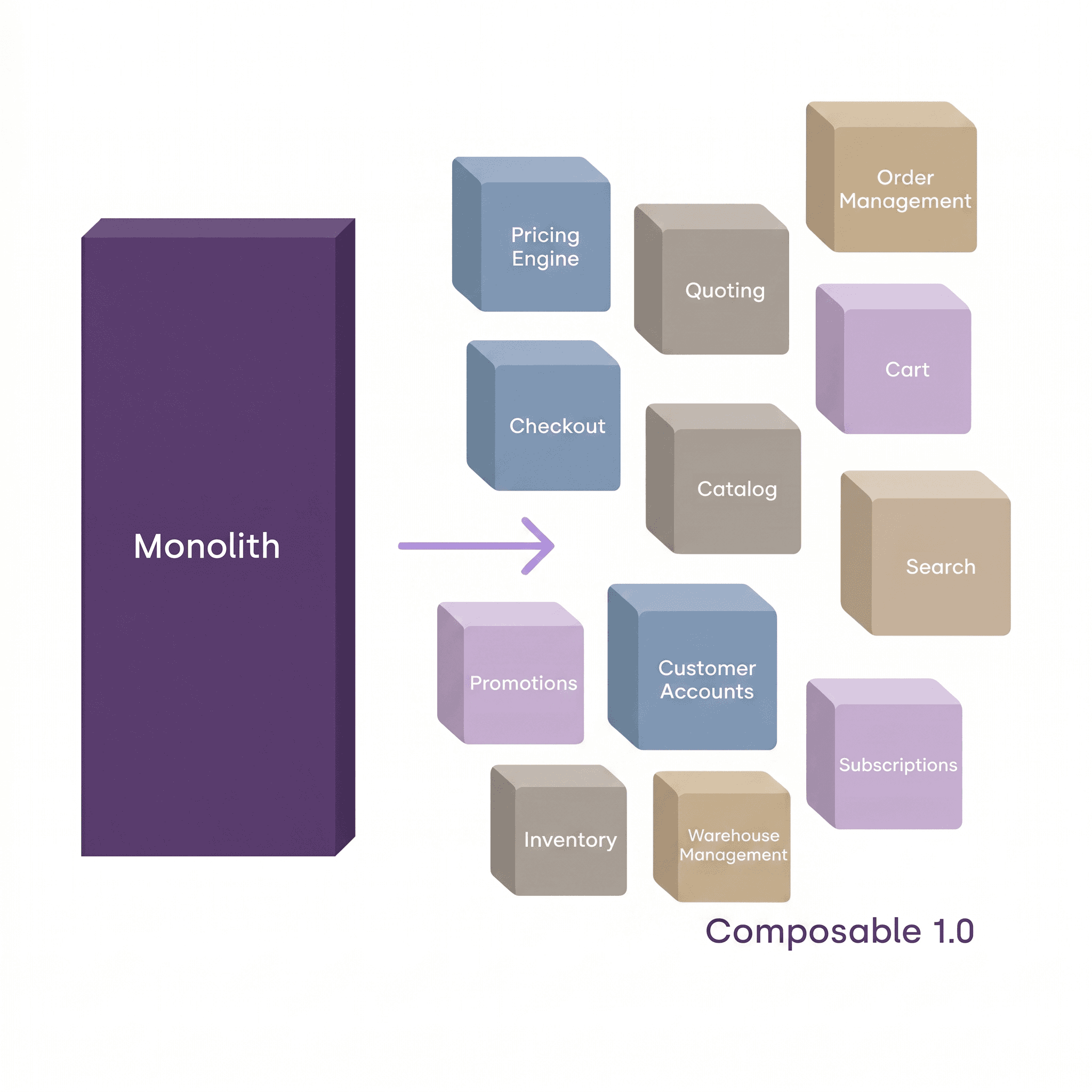
The first generation of composable commerce delivered something important: freedom.
Organizations could break free from monolithic platforms and assemble their own stack. That was a necessary step forward.
At the same time, a pattern emerged.
Many implementations were set up from a technology perspective:
separate services
separate capabilities
maximum flexibility
That worked well — until commercial processes had to run.
What that looks like in practice
From complex inquiry to order — without a manual process
In many B2B organizations, a commercial process does not start with a standard order, but with an inquiry.
For example:
a customer requests a combination of products
specific pricing agreements must be applied
delivery times vary by supplier
additional services or configurations are required
margins must be monitored
exceptions require approval from sales or management
In many organizations, that process is still spread across:
ERP
PIM
Excel
email
separate quotation or CPQ tools
Not because those systems are bad — but because commercial logic has built up over the years.
That is precisely where the added value of modern composable commerce arises. Not by replacing all systems, but by executing commercial processes centrally in a single flow. In practice, this means:
product data from PIM
customer agreements and pricing from ERP
real-time availability from supply chain systems
commercial rules and margins from the commerce engine
automatic approvals for exceptions
quote and order directly linked to the same commercial logic
The result:
fewer manual transfers
shorter lead times
less reliance on specialist knowledge
and much more flexibility to adapt commercial processes without changing the entire landscape
And that is precisely where composable becomes stronger than a traditional monolithic platform: not in standard ordering, but in orchestrating complex commercial processes that are constantly changing.
The turning point: from technology to commercial processes
The most important shift we're seeing now: Successful composable implementations no longer start from technology, but from commercial processes.
In B2B, that means:
pricing doesn't stand apart from quoting
quotes don't stand apart from orders
customer agreements influence everything
These aren't separate capabilities. It's one cohesive commercial process.
The organizations solving this well aren't changing their systems — they're changing the way those systems work together.
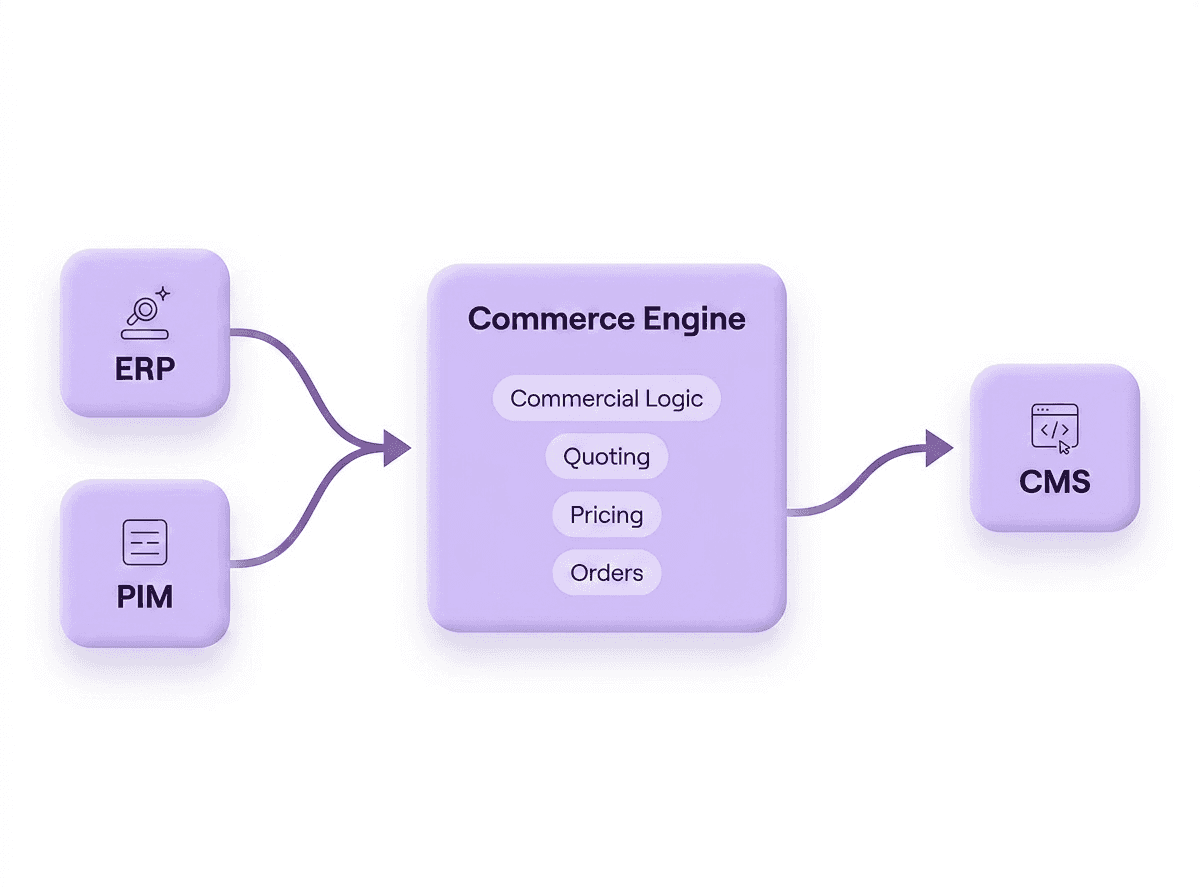
They're creating a place where data comes together and where commercial processes are actually executed. Often in the form of a B2B commerce engine: the layer where commercial logic and processes converge and are executed, based on data from systems like ERP and PIM.
What does work: smart combination instead of decoupling everything
The organizations succeeding with composable today are making a different choice.
Not:
decouple everything
But:
deliberately decide what to keep together and where to bring it together
In practice, that means:
systems like ERP and PIM remain the source of data
a central place where commercial processes are executed
flexibility through configuration (not through fragmentation)
In many modern stacks, this role is filled by a commerce engine where commercial logic and processes converge and are actually executed.
Think of:
an external PIM for complex product data
a CMS for content
existing ERP systems as the data source
The result:
fewer manual steps
more coherence
lower implementation effort
and better control over total cost of ownership
What this looks like in practice
From quote to order — as a single flow
select products
relevant data from ERP and PIM is automatically brought together
customer-specific pricing and agreements applied directly
real-time check on stock and lead times
Extra discount?
immediate insight into margin
automatic approval or approval flow
Quote → customer signs off → order created directly in ERP
Spare parts without friction
customer selects a machine
the right parts from PIM combined with customer data from ERP
prices and availability immediately visible
including suggestions for complementary products
order directly or adjust pricing with approval
Growth with existing customers
the system analyzes customer data and order history
identifies missed products (white space)
a proposal is built automatically
prices and availability applied directly
quote drafted in a single flow
Why implementations are manageable today
A key reason composable works now is that the way of implementing has changed.
Where organizations previously had to assemble a landscape of separate components themselves, we now increasingly see: pre-integrated application stacks
Think of:
a commerce engine
a front-end accelerator with standard B2B functionality
a CMS for content and experience
pre-configured integrations with ERP and PIM
iPaaS solutions for data flows
Often set up by specialized partners and system integrators.
What this means in concrete terms
Instead of:
designing everything from scratch
integrating standalone tools
building complex dependencies
You start with:
a working foundation
proven integrations
existing commercial flows
Result:
less custom development
lower integration risk
lower implementation costs
shorter lead times
faster commercial impact
A real client example
At one of our clients, the quoting process ran across multiple systems: ERP for pricing, PIM for product data, and a separate quoting tool layered on top.
Not because the tools were poor — but because the process had been built up step by step.
In practice, that extra tool turned out to be more of a connector between systems than an accelerator of the process.
By removing that step and centralizing the commercial flow in a commerce engine — directly connected to ERP and PIM — the quote became what it should be again: a direct step toward an order.
That's exactly the role of a modern commerce engine: not adding another tool, but ensuring the commercial process is executed as a whole.
Why this approach works
The difference isn't in technology, but in how you organize it.
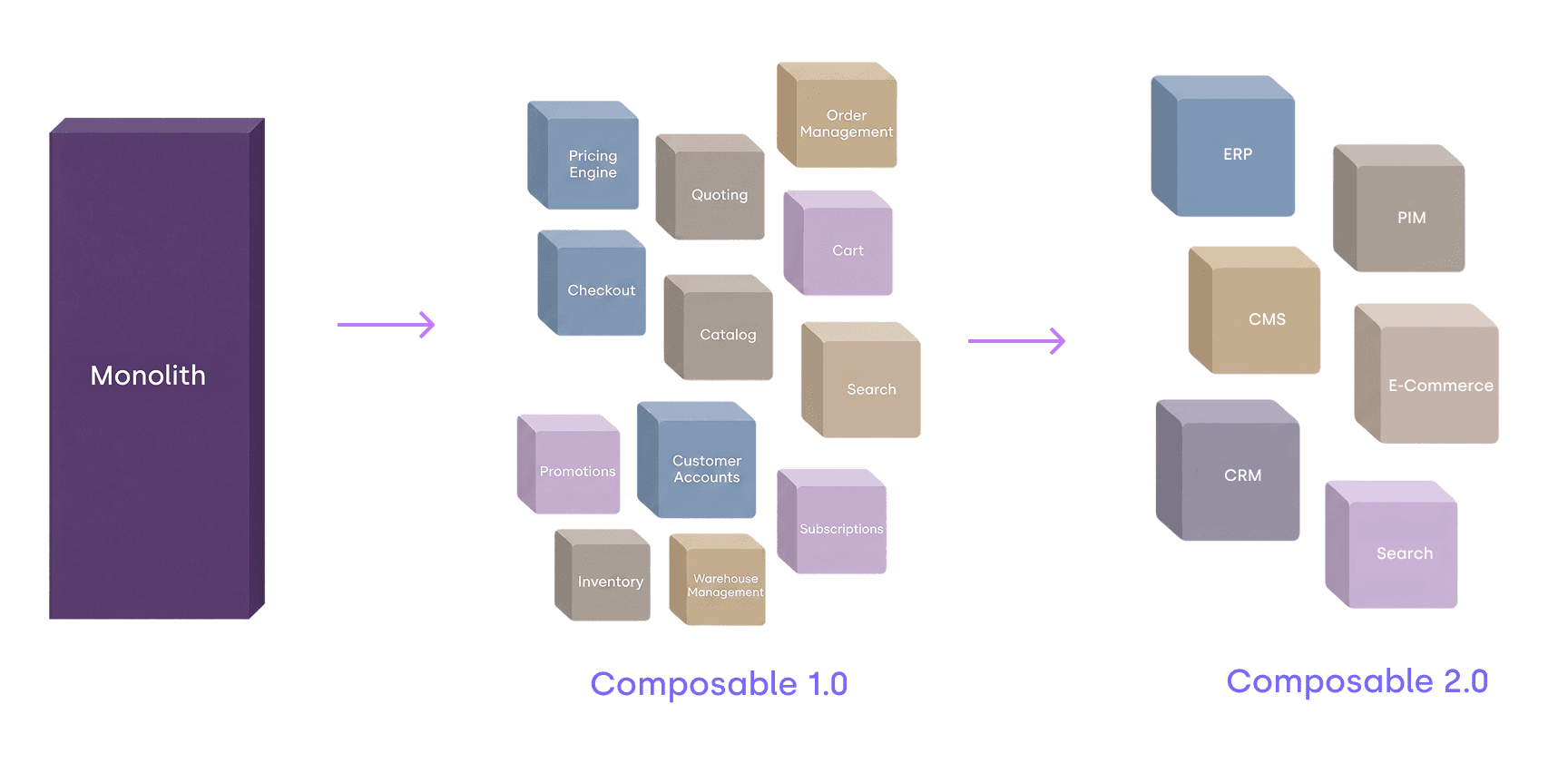
Composable 1.0
focus on individual components
logic spread across systems
fragmented processes
Composable as it works now
data stays in specialized systems
commercial logic is centralized
processes are executed as a single flow
Less complexity. More control. Better scalability.
The question that matters now
The discussion about composable commerce was, for a long time, about architecture. But for decision-makers, the question has become more practical:
"How do we get commercial processes running in a way that's scalable, manageable, and cost-efficient?"
Not:
how many systems you have
how flexible your stack is in theory
But:
how effectively your commercial operation runs
In closing
Composable commerce works. Not by merging systems, but by ensuring they function as a whole.
Data stays where it belongs
Commercial logic is centralized
Processes are executed as a single flow
We're increasingly seeing organizations choose a clear separation:
systems that manage data (like ERP and PIM)
and a central place — the commerce engine — where commercial processes actually take place
Not as added complexity, but as a simplification of the whole.
The question isn't whether you should go composable — but whether you're doing it in a way that accelerates your business rather than slowing it down.