

ERP Was Never Built for B2B Commerce
Why Modern Sales Belongs in the Commerce Layer — Not in Your ERP

Jans Graver
Co-Founder, Propeller Commerce
Published on:
ERP was designed to run the inside of the business — not to collaborate with the outside world.
For decades, ERP systems have been the operational backbone of industrial companies. They manage orders, invoices, inventory, pricing agreements, and financial administration. Without them, most organizations simply wouldn't function.
But somewhere along the way, something changed.
ERP systems slowly became responsible for more and more commercial functionality. What started as an operational backbone evolved into something much broader — a platform expected to support sales processes, product information, quoting, and sometimes even customer interaction.
At first, this seemed logical. Everything in one system. One source of truth.
But in reality, this evolution created a structural problem.Because ERP systems were never designed to support modern B2B commerce.
Historically, ERP systems were built to manage internal enterprise operations — finance, inventory, procurement, and production planning. Their architecture focuses on coordinating processes inside the organization, not facilitating real-time commercial interaction with customers outside of it.
And that mismatch is exactly where many B2B organizations run into friction today.
The ERP Gravity Trap
We often see organizations fall into what we call the ERP Gravity Trap.
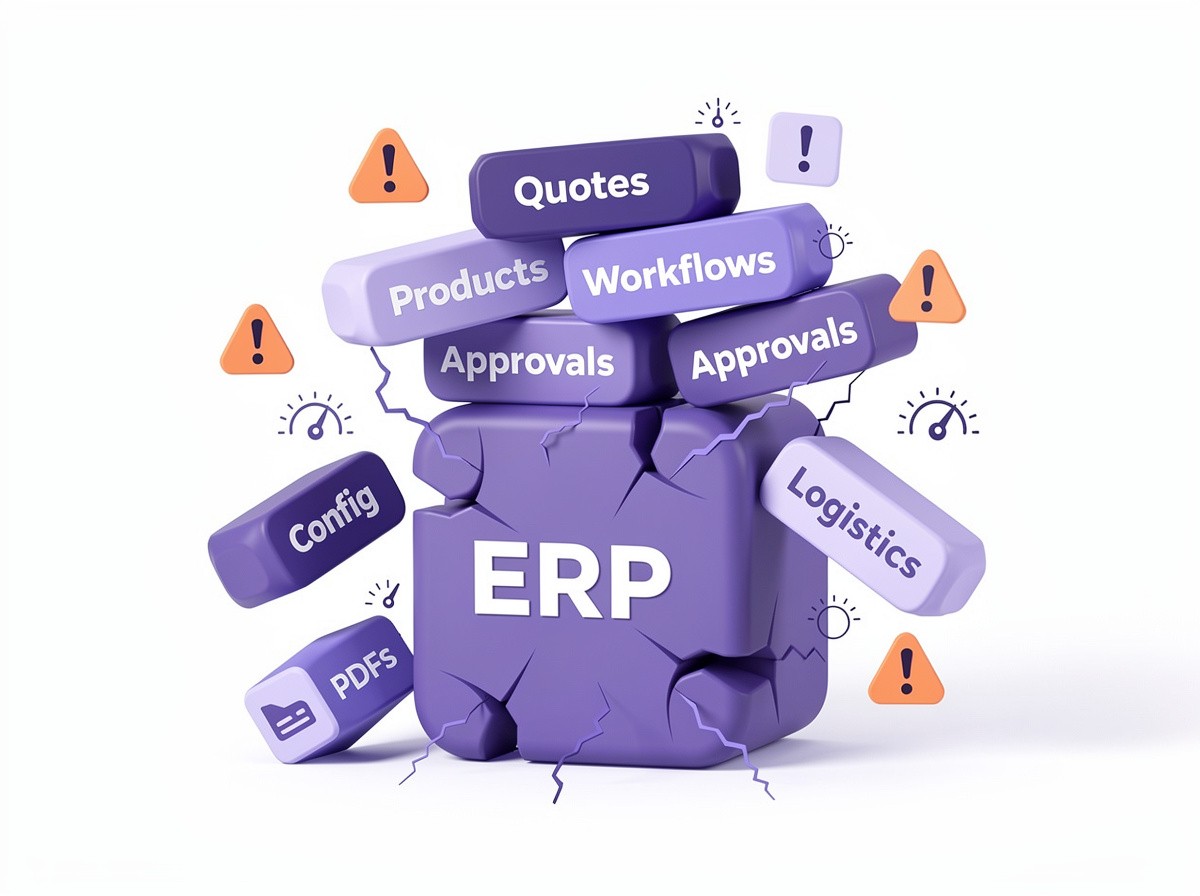
ERP sits at the center of the IT landscape. It's stable, trusted, and deeply embedded in operations. Because of that central role, every new requirement tends to gravitate toward it.
Over time, ERP becomes the place where everything ends up.
But this expansion rarely happens cleanly.
Sales modules are added to allow representatives to create quotes and orders. Product tables grow larger to accommodate more product information. Workflow layers appear to manage approvals.
And when the standard ERP functionality still doesn't meet commercial requirements, companies often take another step: they build custom layers on top of the ERP system.
We've seen organizations develop custom quoting engines, product configuration layers, or approval workflows directly inside ERP environments. Initially these solutions solve a real problem. Sales teams need flexibility, and ERP simply wasn't designed for dynamic commercial processes.
But these custom layers introduce a new challenge. They are expensive to build. They require ongoing maintenance. And most importantly — they rarely evolve. Because they are tightly coupled to ERP, every upgrade becomes complex. Innovation slows down. What started as a pragmatic workaround gradually turns into technical debt.
Eventually companies find themselves with sales tooling that is critical, but fragile. It works — but nobody wants to touch it anymore.
And that's exactly the opposite of what modern B2B commerce requires.
ERP Is Built for Operational Control — Not Commercial Agility
ERP systems are extremely good at what they were originally designed for: operational integrity.
They ensure that every order connects to the right customer, the right pricing agreements, the right inventory levels, and the right financial records.
This reliability is essential.
But commercial processes require something fundamentally different.
Modern B2B sales requires flexibility, collaboration, and rich information. Sales teams need to compare products, configure solutions, adjust offers, and iterate with customers quickly.
ERP systems were designed to record transactions, not to enable commercial interaction.
ERP records transactions.
Modern commerce requires collaboration.
That difference matters.
Why Product Data Doesn’t Belong in ERP
One of the most common side effects of the ERP Gravity Trap is the attempt to manage rich product information directly inside ERP. This rarely works well.
ERP data models are designed for structured master data, not for the complex product information required in modern B2B sales. Think about what product information looks like today:
Technical specifications
Variant structures
Documentation and manuals
Visual assets
Compatibility information
Spare parts relationships
Marketing descriptions
This type of information belongs in a Product Information Management (PIM) system.
A PIM allows organizations to enrich, structure, and distribute product data across channels. It supports richer data models without impacting ERP performance.
ERP should store product master data — not attempt to manage the entire commercial product experience.
ERP manages product master data. PIM manages product intelligence.
The Email Attachment Problem
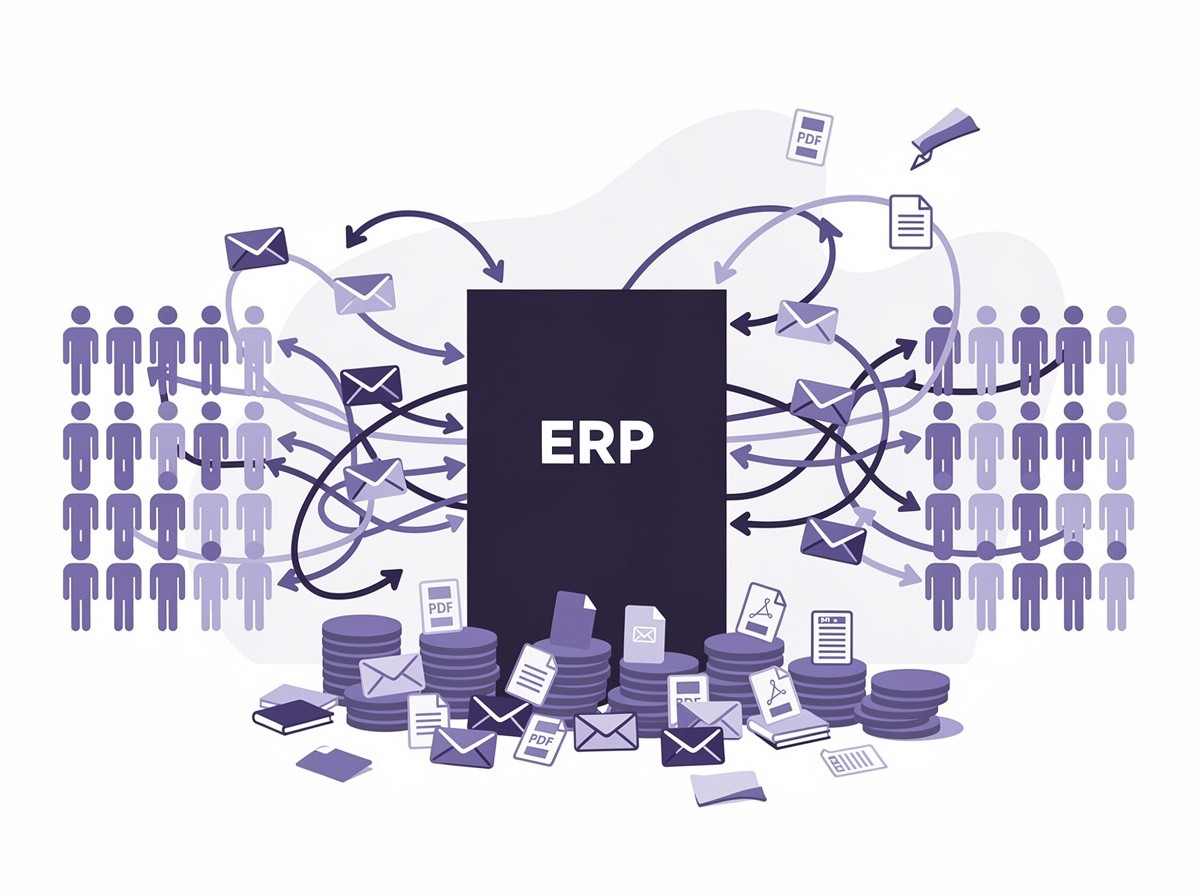
Another symptom of ERP-centered sales processes is how quotes are shared with customers. The typical process looks like this:
A quote is created in ERP
The quote becomes a PDF
The PDF is emailed to the customer
Feedback arrives through email
A new version is created
Another attachment is sent
Over time, a single opportunity can generate dozens of email threads. This approach creates several risks:
Customers reviewing outdated versions
Incorrect bills of material being approved
Lost context in email conversations
Limited transparency for both sides
But beyond these risks, it simply doesn’t match how modern buyers want to interact. Email attachments are not a collaboration platform. Today’s B2B customers expect something very different.
Modern B2B Customers Expect Digital Interaction
In many industries, B2B buyers now expect the same transparency and convenience they experience in digital commerce. They want to:
View quotes online
Compare products and specifications
Adjust quantities or configurations
Ask questions directly within the quote
Approve offers digitally
Track order progress
In other words, they want a shared digital workspace where they can collaborate directly with the sales team.Not another email attachment.
The Case for a Sales Hub
This is why we believe quoting and ordering processes should move out of ERP and into the commerce layer.
Not because ERP is failing — but because ERP should focus on what it does best. In a modern architecture, ERP remains the operational backbone, responsible for:
Financials
Inventory
Customer master data
Pricing agreements
Order processing
But the commercial interaction layer moves into a dedicated environment: a Sales Hub (or Seller Hub).
A Sales Hub is a digital workspace where sales teams and customers collaborate around opportunities.
It becomes the place where all commercial interactions come together — including sales conversations, quotes, orders, and the online commerce channel.
Instead of sending documents back and forth, both parties work within the same environment. They can:
Create and iterate on quotes
Compare product specifications
Configure solutions
Adjust pricing scenarios
Approve orders digitally
Monitor customer activity in the online commerce channel
Sales teams gain visibility into what customers explore online. Customers interact with the same pricing logic and product information — whether they work with sales or through the online portal.
Both sides always work on the latest version. Collaboration can happen synchronously or asynchronously without losing context.
In modern B2B commerce, there is no real distinction between “online” and “offline” sales anymore.
There is only one commercial journey — supported by multiple channels.
Bringing Commercial Data Together
Moving quotes and orders into the commerce layer unlocks something powerful. All commercial data starts to live in one place. This includes:
Product information from PIM
Customer-specific pricing
Sales history
Quotes and negotiations
Orders and reorder patterns
Product configurations
When these datasets are connected, companies gain something they rarely have today:
A true 360-degree commercial view of the customer.
Not just financially — but commercially.
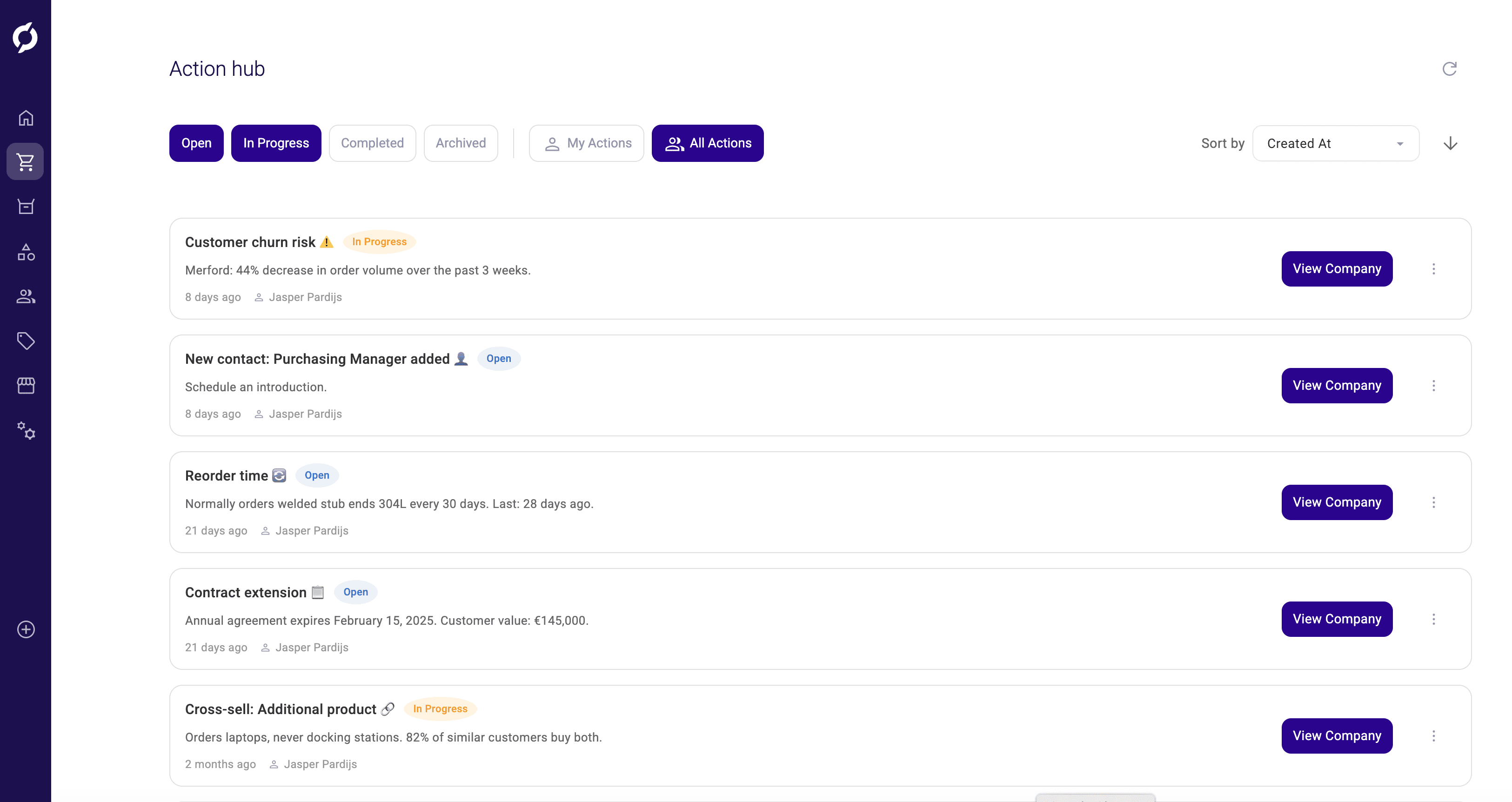
Turning Data into Opportunity Intelligence
Once commercial data is unified, it becomes actionable.
Workflows can automatically identify opportunities such as:
Customers not ordering certain product categories
Compatible spare parts never purchased
Quotes that were never converted
Accounts with declining order frequency
AI agents can assist sales teams by recommending:
Cross-sell opportunities
Better product alternatives
Margin improvements
Smart reorder suggestions
Instead of acting as a passive system of record, the commercial platform becomes an active growth engine.
The system doesn’t just process orders.
It helps sales teams discover the next opportunity.
Let Systems Do What They’re Good At
The architectural principle behind this shift is surprisingly simple. Every system should focus on its core competency.
ERP → operational integrity and financial control
PIM → rich product information management
Commerce / Sales Hub → customer interaction, quoting, ordering, and opportunity management
When these roles are clearly separated, each system becomes stronger.
ERP becomes more stable and performant.
Product data becomes richer and easier to manage.
Sales processes become faster and more collaborative.
Most importantly, the customer experience improves dramatically.
Escaping the ERP Gravity Trap
Many companies still see ERP as the natural center of their digital architecture. But in modern B2B commerce, that center is shifting. ERP remains essential — but it should no longer define how companies sell. The commercial experience belongs in the commerce layer.
This is where customers interact. Where sales teams collaborate. Where product data becomes meaningful. Where opportunities are identified and captured.
Companies that escape the ERP Gravity Trap gain a structural advantage. They move from managing transactions to creating commercial momentum. And in today’s competitive B2B landscape, that difference matters more than ever.
A Perspective from Propeller Commerce
At Propeller Commerce, we believe the future of B2B sales lies in bringing commercial interaction, product intelligence, and customer insight together in one environment.
ERP remains essential as the operational backbone of the business. But the commercial experience — where customers interact, where sales teams collaborate, and where opportunities are created — belongs in the commerce layer.
This is where product data from PIM, pricing logic, quotes, orders, and customer behavior converge. It’s where online and offline channels finally become one coherent commercial journey. When companies make that shift, something interesting happens.
Sales teams gain visibility.
Customers gain transparency.
Organizations unlock the ability to turn commercial data into real opportunity.
Because modern B2B commerce isn’t just about processing orders. It’s about creating momentum between companies and their customers.